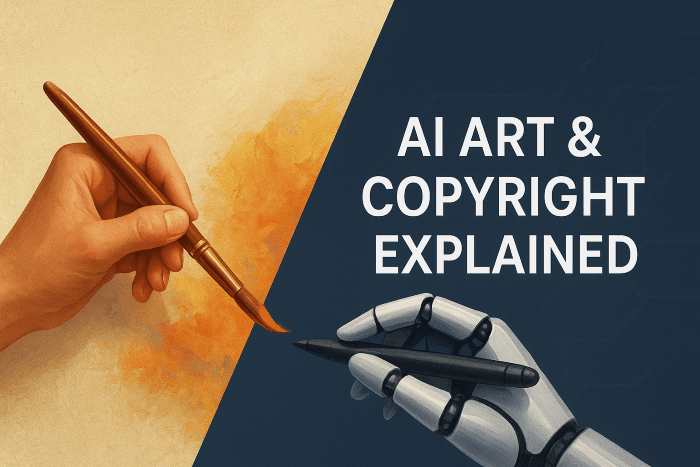
Introduction: Who Owns AI-Generated Images?
Artificial intelligence has made image creation faster, smarter, and – let’s be honest , more magical than ever. From artists using Midjourney to marketers designing with DALL·E, millions of visuals are now born through algorithms, not paintbrushes.
But here’s the million-dollar question: Who owns AI-generated images?
If an AI tool made it, can you claim it? Or does it belong to the AI company, the coder, or no one at all?
Let’s break it down clearly, so you know exactly what’s fair (and legal) in the world of AI art and copyright.
🧠 Understanding AI-Generated Images
AI-generated images are visuals produced using machine learning models that have been trained on vast datasets of human-created content. These models , like DALL·E, Midjourney, or Stable Diffusion , can create unique art pieces, logos, and photos from simple text prompts.
For example, you could type:
“A futuristic city skyline at sunset, painted in cyberpunk style”
…and boom , an image appears in seconds.
But that convenience brings complexity. Because even though the prompt was yours, the creation wasn’t entirely human-made , and that’s where copyright law starts to blur.
⚖️ What Copyright Law Says About AI Art
Copyright law was designed to protect human creativity. It ensures that creators get recognition and control over their work.
However, AI isn’t a “person” , it can’t hold rights or intentions. So when an AI tool creates an image, traditional copyright rules struggle to apply.
📜 The Basic Rule (as of 2025)
If no human authorship is involved, the image cannot be copyrighted under current U.S., U.K., or Indian law.
That means:
- AI tools like DALL·E or Midjourney cannot “own” the image.
- You, as the prompt writer, might only have limited usage rights.
- The image might fall into the public domain , meaning anyone can use it.
🧩 Real-World Examples and Legal Cases
Let’s look at how this has played out in real life.
1. The “Théâtre D’opéra Spatial” Case (U.S.)
An artist named Jason Allen created a stunning AI image using Midjourney and won an art contest.
When he tried to copyright it, the U.S. Copyright Office denied the claim , stating that “works produced by a machine without human authorship cannot be copyrighted.”
Lesson: AI art can be beautiful, but legally, it’s not considered human-made.
2. The “Zarya of the Dawn” Comic Case
Artist Kris Kashtanova used Midjourney to generate images for a comic book.
Initially, the U.S. Copyright Office approved the copyright , but later revoked it after discovering that the images were AI-generated. Only the text and human edits were protected.
Lesson: Human contributions (like writing, editing, or curating) can still qualify for copyright.
3. India’s Current Viewpoint
India doesn’t yet have a clear AI copyright framework, but under the Copyright Act, 1957, the “author” is typically the person who causes the work to be created.
This means:
- If you use AI as a tool (with your creative direction and editing), you might claim authorship.
- But if the AI creates everything autonomously, it’s legally uncertain.
💡 So, Who Actually Owns AI-Generated Images?
The short answer: It depends on how much human involvement there is.
Here’s a simple breakdown 👇
| Scenario | Ownership Status | Explanation |
|---|---|---|
| You fully let AI generate the image | ❌ No ownership | Considered non-human creation |
| You edit, enhance, or combine AI images | ✅ Partial ownership | Your human input matters |
| You train your own AI model using custom data | ✅ Strong ownership | You own both data and outcome |
| You use a commercial AI tool (like Midjourney) | ⚠️ Depends on terms | You get usage rights, not copyright |
🧾 Understanding AI Tool Terms of Use
Before you claim any ownership, it’s smart to check what your AI tool’s license says.
Here’s how the big ones compare:
🧩 Midjourney
- You own the images you create, if you have a paid account.
- Free users’ images are publicly viewable and reusable.
- You grant Midjourney a license to use your images for training.
🎨 DALL·E (OpenAI)
- You own the rights to the images you generate.
- You can use them commercially.
- OpenAI retains the right to use your prompts for improving the model.
🔮 Stable Diffusion
- Open-source, meaning anyone can use and modify it.
- Ownership depends on how you use it.
- If you customize or train your own version, you can claim stronger rights.
🖼️ When AI Acts Like a Tool, You’re Still the Artist
Think of it like using Photoshop, a camera, or even a paintbrush.
If you decide what to create, direct the process, and make creative choices, you’re the author , even if AI helps along the way.
For example:
- Craft a detailed prompt first.
- After testing multiple outputs, select the final image.
- Make enhancements or edits as needed.
That level of human direction and intention is what courts often recognize as authorship.
🔍 A Quick Self-Test: Are You the “Author”?
Ask yourself these three questions:
- Did I guide the AI creatively (not just randomly click “generate”)?
- Did I select, modify, or combine outputs intentionally?
- Would the image look different if someone else wrote the same prompt?
If you answered yes to at least two , chances are, you have some claim to the image.
🧠 My Personal Experience with AI Image Ownership
At FixMyAI.in, we’ve experimented with nearly every major AI image tool since 2022. I remember generating my first “AI robot painting a human” in Midjourney , and feeling amazed, but also confused: Can I really call this mine?
After reading the terms carefully, I realized that while I could use it freely, I didn’t truly own it in the legal sense. That sparked my journey into exploring AI copyrights deeper , and led to this guide.
So yes, it’s exciting, but also tricky. Always read the fine print before publishing or selling AI-made art.
💬 What About Selling AI-Generated Art?
Good question. Platforms like Etsy, Redbubble, and Shutterstock have updated their rules:
- You can sell AI-generated images if you disclose that they’re AI-made.
- Some marketplaces (like Adobe Stock) only accept AI art if it’s properly labeled.
- However, claiming exclusive copyright ownership is often restricted.
If your goal is monetization, it’s better to:
- Mix AI art with human edits.
- Add original design elements.
- Keep records of your creation process.
This not only protects your rights but also boosts authenticity and trust with buyers.
🌍 The Global Copyright Landscape (2025 Update)
Different countries have started exploring AI copyright reforms. Here’s a snapshot:
| Country | Current Stance | Notable Update |
|---|---|---|
| USA | Only human authorship protected | Several AI art claims rejected |
| UK | Recognizes “computer-generated works” if author made creative input | Ambiguous for full AI creations |
| India | Human-driven works protected | AI-only works remain unprotected |
| EU | Moving toward shared authorship models | Proposal under review (as of 2025) |
| China | AI-assisted works allowed with human contribution | AI-only works may be public domain |
💼 Tips to Protect Your AI Art Legally
If you’re using AI images professionally – for clients, social media, or products , follow these smart steps:
- Read the license agreement of your AI tool carefully.
- Keep your prompts and edit history – they prove your creative role.
- Add human elements – text, retouching, composition tweaks, etc.
- Register your final artwork (if eligible) with copyright offices.
- Disclose AI use transparently – honesty builds trust.
🧩 Pro Tip: Combine AI with your photography, illustration, or design work. This hybrid style gives you stronger copyright standing – and a unique artistic edge.
🤖 The Future of AI Image Ownership
As AI gets smarter, the question of “Who owns AI-generated images” will only get more complicated.
Legal experts predict that by 2027, we may see new copyright categories for AI-assisted works, where ownership is shared between the human and the model creator.
That’s why staying updated is crucial. Platforms like FixMyAI.in track these evolving laws so creators like you can stay safe, informed, and ahead of the curve.
🧭 Final Thoughts: So, Who Owns AI-Generated Images?
To wrap it all up:
- Pure AI creations (no human input) → No copyright.
- AI + human guidance → You may claim partial authorship.
- Always check tool licenses → Your usage rights depend on them.
- Transparency is key → Be honest about AI involvement.
AI is reshaping creativity, but ownership still belongs to those who guide the process with human intention.
If you’re using AI tools to create, sell, or brand visuals – stay informed, stay ethical, and let your human creativity shine through the code.
✨ Did this post help you understand AI image ownership?
Share it with your friends or leave a comment on FixMyAI.in – your hub for smart AI tips, monetization insights, and automation hacks.
Great content